“What shall I learn of beans or beans of me?” Henry David Theroux, Walden.
After a turbulent night of sleep, victim of a racing mind which couldn’t resist comprehending this next stage of life, I was finally on my bicycle – riding from Clifton to Grace Gardens where my first day at Ruskin Mill Trust awaited. The journey is short, no more than 15 minutes on two wheels and as I ride my body is bubbling with excitement. Grace Gardens – the place of my new apprenticeship – lies half a mile South of Blaise Castle, tucked into the side of a gorgeous Valley in a clearing surrounded by towering deciduous trees. Ruskin Mill Trust (RMT) was established three decades ago in Nailsworth, South Gloucestershire, where a college was developed to offer students with complex learning needs a skills based education that fosters the development of the hands, heart and mind. The trust is influenced by the work of Rudolf Steiner whom saw the benefits of a therapeutic education style that enabled students to learn in a meaningful and practical manner. RMT now has eleven colleges and schools in the UK, the most recent to establish being Grace Gardens in North Bristol, which received its first student in early July. Key to each of the colleges curriculum is the growing of food and this is this branch of Grace Gardens that I will be focusing on, as a biodynamic agriculture trainee.
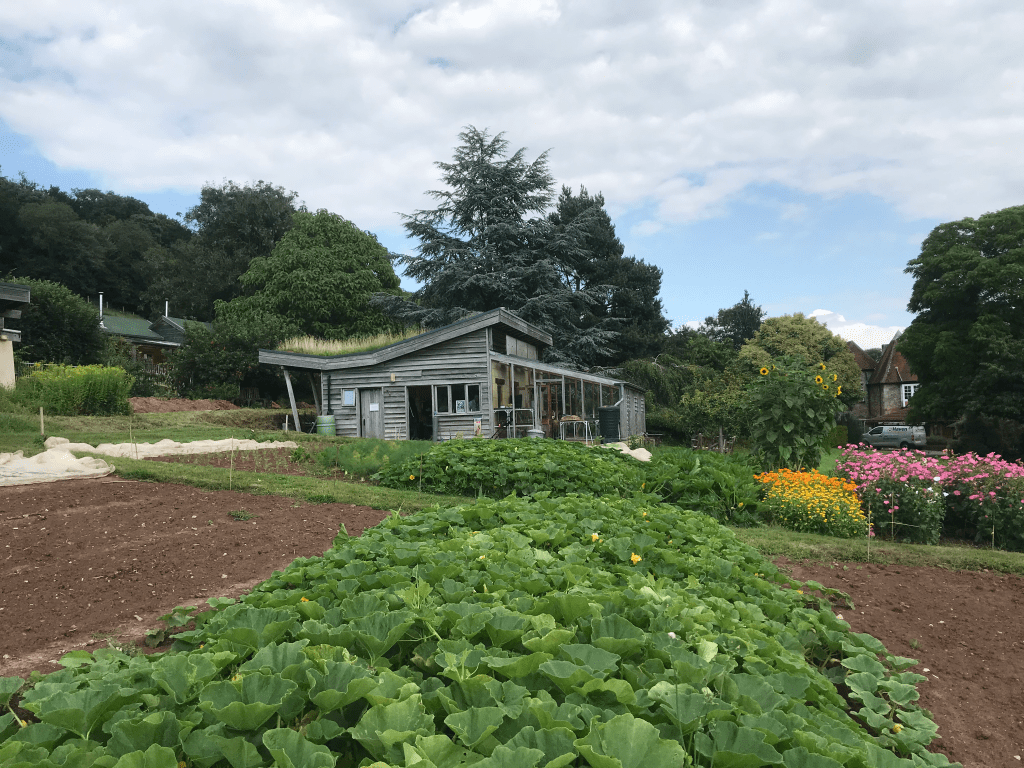
The ‘Garden Shed’ built by the Camp Hill Community that previously owned the site.
Turning into the drive I slow down to a snail’s pace – listening to the confident calls of song birds and feeling the cold damp air that seems to permanently sleep at the bottom of the valley. On arrival I am warmly greeted by the receptionist, Julia, who walks me over to the market garden where my mentor for the next two years is busy at work. Peter is originally from Holland and has been practicing biodynamic agriculture for more than four decades. I have been reassured by many members of staff at RMT that I am in very knowledgable hands. The market garden sits on a gentle plateau in the Valley where approximately 1/4 Acre is used for growing crops on a 7 year rotation. Within a few minutes of finding Peter, I am assigned my first task which is to dig up potatoes that were planted in mid-march. The heavy clay soil is flocculated, making it difficult to work with, stubbornly wanting to remain glued together in heavy clumps. I recall the words of John Seymour in ‘The complete book of self-sufficiency’ whom emphasised the great skill required to farm clay soils effectively. Left to continue with my task – which I carry out willingly, I stop frequently to give myself metaphorical pinches to make sure I am not dreaming. What a pleasure to get to work outside in such a green oasis. As I dig, several other members of staff walk over to introduce themselves, first is Nathalie who is a land teacher for the students that will be attending the Grace Gardens School. Her kindness is instantly apparent and she reminds me in all the best ways of my Auntie, Sarah. Second was Malcom who’s handshake is all that you would expect from a man who works the land – his role encompasses livestock care of which there are three Dexter cattle, three Hebridean sheep and around 20 chickens (Soon to be joined by goats and pigs).

The Hebridean sheep grazing in the orchard.
Digging the potatoes takes Nathalie and I through until a morning break where we stop to enjoy a lovely cup of coffee with Peter. I sit and enjoy listening to the conversation of Peter and Nathalie, occasionally chiming in with questions as they discuss planting schedules, harvesting and the students land work. After our break I get a lesson in Hoeing, a job I have never done before and which requires a delicate attention in order to clear the weeds between the brassicas without damaging their stems which hide below the dark green leaves. Watching Peter complete this task, it appears effortless, not only does he move through the rows of cabbage at great speed, he also keeps his back straight at all times, the necessity of which I am all too aware of if I am going to hack it as a food grower.
In the afternoon Peter and I take a walk around the site in order for me to get a clearer understanding of the land, how it is managed and what the plans are for its use. First we stroll down to the bottom of the valley and into Finger Fields which runs parallel to the stream that flows East to West. The field is slowly being engulfed by brambles which are progressing down the steep South facing slopes that the tractor cannot access. Peter tells me there is a herd of goats in Bristol that can be hired for grazing such an area, although their tenacity would still require several years for them to work through it all. At the bottom of the field where the land is flatter there are several humungous trees which came down during winter and still lye like sleeping giants across the stream. Both this field and the next we walk through share a similar topography and experience flooding at different times of the year. We climb back up the steep slope of the field to say hello to the cattle, Aspen (Grandmother), Cedar (mother) and Oak (child), whom are grazing happily under the shade of an apple tree. Next we visit the chickens who scamper towards us in hysteria in the hope that we have some food to offer, the lack of which is responded to with grumpy clucking. The remaining fields which are also used for grazing are empty and beyond which stand the woods that join up with Blaise Estate. These steep fields will soon house goats which are coming from a farm near Stourbridge. The site is a total of eighteen acres and within it contains a vast amount of wildlife. Towards the end of my second week, I started to jot down all of the birds I have so far spotted or heard; wood pigeon, wagtail, buzzard, green woodpecker, sparrow hawk, robin, jay, crow, jackdaw, magpies (lots of them) and kestrel. I have also seen slow worms, a wood mouse and even a fox. Malcom calls him the no-tailed fox, I ask if it may have been shot off by a farmer, but we both agree that this would be a little too Fantastic Mr. Fox-esque.
The proceeding four days of my first week at Grace Gardens are as enjoyable as the first and entail an array of jobs that keep me busy. On Wednesday I helped to plant out several beds of ruby chard in the area where I harvested the potatoes from earlier in the week. Chard cultivars are decendendts of Sea beet and we plant them out in three rows with 35cm gaps between each plant. The tool I use is what Peter calls a planting knife and originally belonged to his Grandfather, making it over 100 years old. I wonder how much food has grown with the help of this trusty instrument? I help to plant out several more empty beds throughout the week, putting in Florence fennel, radicchio, New Zealand spincach, kale and more ruby chard. Each of this are spaced at similar distances apart from the kale, which grows much larger and so is given gaps of 60cm. As well as planting out, Peter teaches me some lessons in sowing and pricking out – both delicate art forms. The seeds of winter purslane, utterly beautiful, but awkwardly small, makes sprinkling them evenly quite a challenge – like the BFG trying to work with peppercorns.
By the time Friday evening arrives I am pretty exhausted, it has been a tough week physically, however each day has been interesting and full of new information. I feel content that I have made a good decision for my next patch of post-university learning and feel extremely grateful that I have the opportunity to develop the skills required to grown and produce food in a manner which works in cooperation with nature, rather than in competition with it.


 Bricolage Gardening
Leave a reply to spoonmcdonaldicloudcom Cancel reply