song sharing – paths old and quiet – naked plunge – the beetle that follows – me and ben meandering
In tides of green
And meadows sweet
In forests tall
Sing for us all
In times of greed
Where flowers weep
In rivers old
Swim for us all
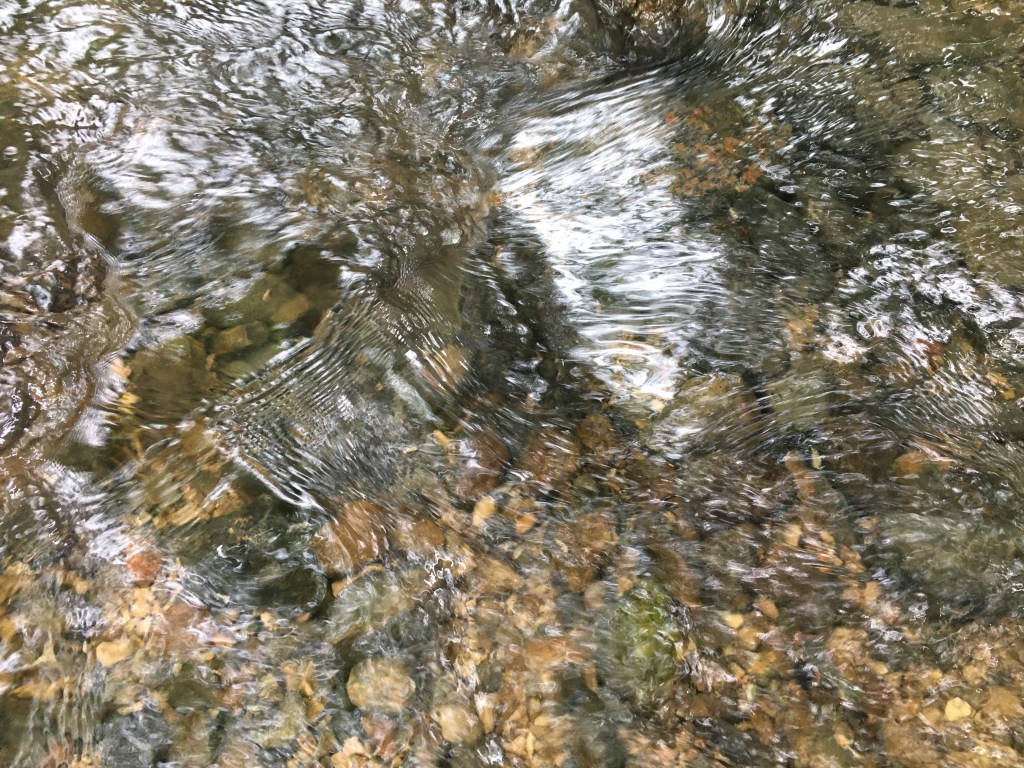
Chwefru, ‘the moving, gushing water’ or ‘winding water’, is one of the several suggested name origins on Wikipedia for the River Chew. Cyw, cēo, chowe and Tiw offer up alternative roots with varying supposed etymologies. When put into a translator from Welsh to English I’m told Chwefru actually means to act violently, which could well allude to the river’s more aggressive and untamed past. Despite etymological uncertainties, the description of moving and winding water is what settles gently in my mind.
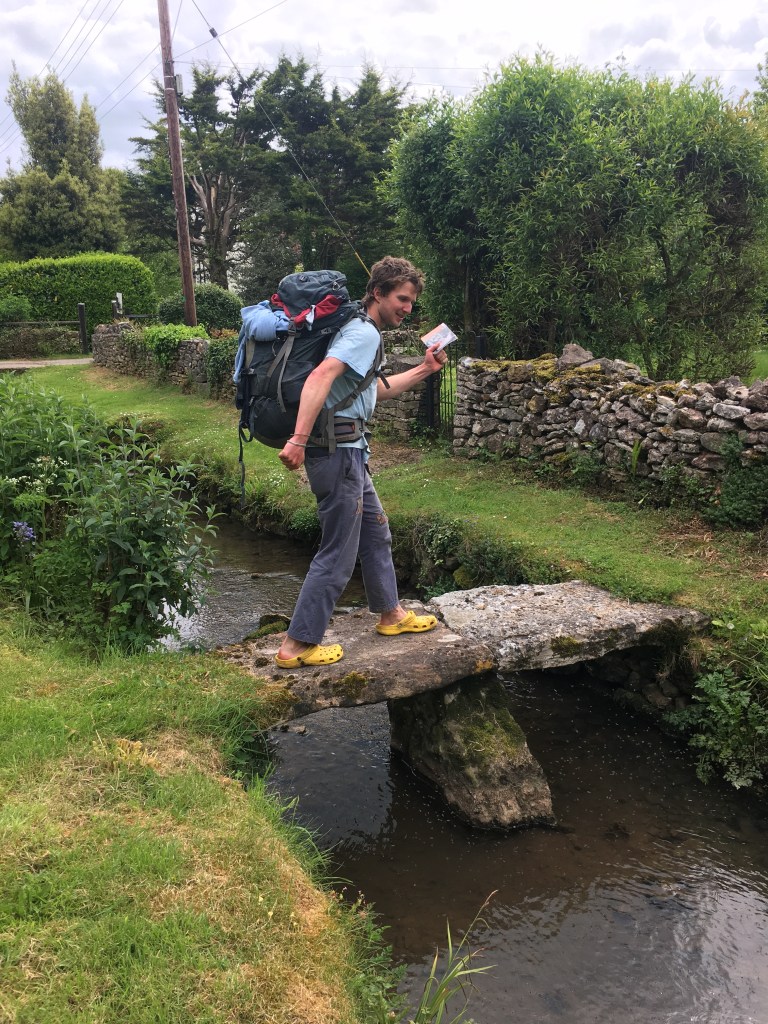
It’s early evening, warm and verdant when ben and i leave Codrington Cottage. Jam jars filled with milk, frozen hummus and a rug weigh down my rucksack, reflecting the rush out the door and what feels like a lifetime since my last camp out and the knowledge of what to bring.
A cluster of rabbits in the first field we enter are a sign of the wildlife encounters to come in the following twenty four hours. Simultaneously reflecting the staggering diminishment of biodiversity in England, but also the hopeful capacity of Nature to flourish in what pockets are left.
We are setting out on an adventure we have loosely been referring to as ‘source to mouth’, an idea I have been ruminating on for a while; to navigate the entirety of the River Chew. The details of how this might pan out have been illusive from the get go; what time of year? Can we do it in a day? Where is the source? Could we kayak across the lake without being attacked by fishermen? With summer arriving and water levels diminishing, doing something soon seemed necessary.
With limited free time, finding the source of the Chew seemed like a logical place to start and so it was against the grain that we began, travelling towards the beginning.
With Stanton Drew at our backs we leave the fields and follow a nameless path that seems to carry the signs of an old byway or drove road for moving animals, now heavily overgrown with the hedgerows either side almost joining in the middle. At our shins grows vetch, a favourite of mine, but never in my catalogue of edibles, so i was delighted when Ben reached down to pick off a furry leafed shoot and popped it in his mouth.
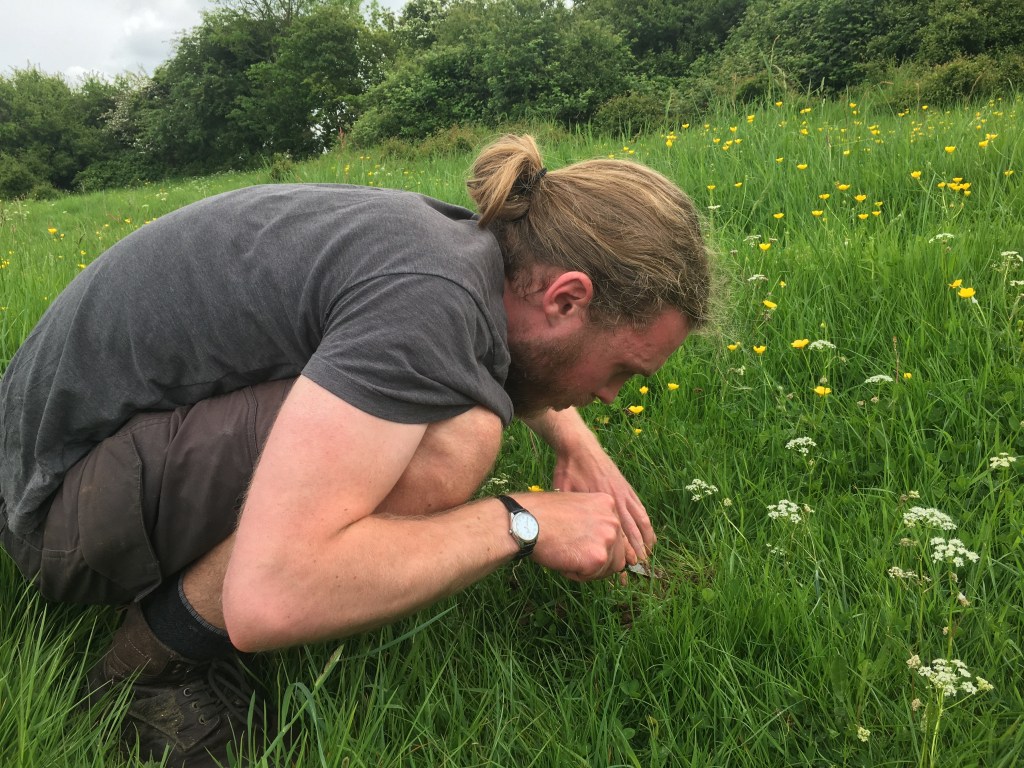
Spending time with Ben is akin to having Ray Mears by your side, but with the additional perk that he carries with him an array of folk songs, often curated by himself. We first met in bristol through a mutual friend, where Ben offered to teach me keyboard, the latest iteration in my attempt at learning a musical instrument. Needless to say, the keyboard is a pastime that remains there, but fortunately the friendship has flourished, often under trees, in rivers, atop’ rocks, and with fortune; accompanied by song.
The old pass reaches to the top of Folly woods and from there we hop a fence and walk in the direction of Dowling woods where we join up with a footpath, which at almost 190m above sea level offers one of the highest points in Chew Valley and provides a beautiful panorama of the lake and surrounding hills.
We stop to set up camp in a cluster of trees that i have daydreamed of camping under for a while and upon setting up we were excited to find an elaborately graffitied beech tree that must have been carved many decades ago.
Amongst other plant-based tricks that ben keeps up his sleeves, he has brought some carefully collected tinder for starting a fire with flint. The fluffy grey seed heads of travellers joy and shavings of birch bark he had foraged lit with ease and before long we have a pleasant fire on the go.
With minimal effort in mind, i chose to sleep with my hammock splayed out on the long grass and ben too choosing to sleep on top of his tent rather than inside it. The open air sleeping arrangement had its, perks, notably, seeing the deer stroll past our camp in the middle of the night, awaking us both and quickly scampering off. The downside of the alfresco set up was an abundance of slugs that had worked their way over us during the night, including a few which we found knotted in our hair.
Being so close to Dowling and Folly woods meant a dawn chorus with incredible variety and depth, what could be described as ‘thick’ in musical terms! This year the birdsong has seemed to carry an extra element of awe to it, perhaps due to the excessively wet and grey winter and spring we have had to navigate. After a nutritious breakfast of boxed cereal, peanut butter and a cigarette, we began the days ramble, starting in the direction of Stowey.
A mere four miles from home, but on new footpath territory, we walked towards Castle woods, loosely following the course of a small stream, fed by two very beautiful valleys; one between Burledge hill and Sutton hill and the other carrying the name of ‘Barleges brake’. Googling now, a brake is defined in geographical terms as a marshy or overgrown landscape. On the map there appeared to be a small pond shouldering castle woods which we thought might do for a swim, but on arrival its appearance was less than inviting. We did however find some fresh turkey tails, unusual at this time of year, but a happy discovery for us, filling pockets to be used for immunity boosting teas.
Following a quick foray to the top of the castle (site of), we rejoined the footpath and headed back down to the stream where we dropped our bags and clothes to refresh ourselves with a skinny dip. The stream had carved a selection of plunge pools and we tested a few, in water that was cold in all the right ways. The water moved at a gentle pace, singing the song that streams do as it ruffles along the rocks and root of the landscape. This stream feeds the Chew after joining up with water from Stowey and the hills that folly and Dowling woods stand on and meets the lake in about three miles at hollow brook, east of denny island.
Slate cleansed from the swim, we once again walk, making the challenging ascent to 174m above sea level where the trig-point of Burledge Hill sits. Here, ben spots pig nuts and so the bags are once again dropped so that we can forage one. Delicately following the stem with his knife, digging to around five centimetres below the surface where the plant stores a hazelnut shaped tubor. Brushing off the mud, we break it in two and i am surprised by the creamy and slightly nutty flavour of the tubor. I find with several foraged food that the concept is more palatable than the plant itself, but in the case of pignuts, their taste needs no defending.
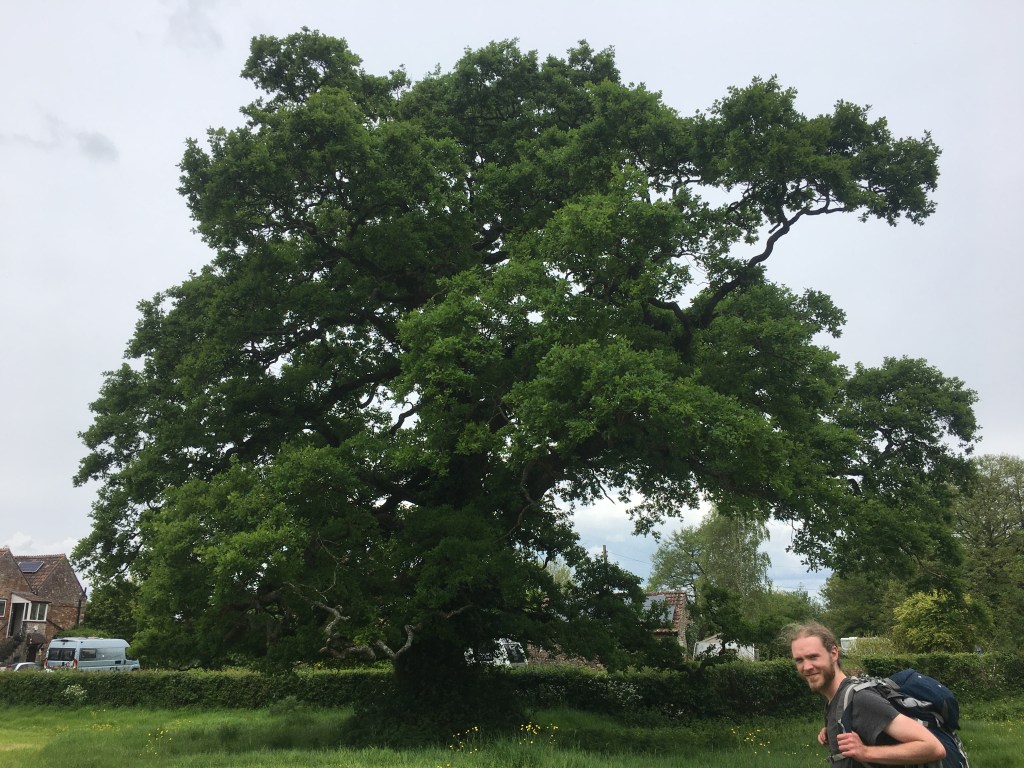
The footpath along Burledge Hill joins up with a more sophisticated track, which given its connection to a fort, might have quite ancient roots. We descend to North Widcombe, close to Herriotts Bridge where birds, birdwatchers and icecream vans flock to in fair weather. Here, we link up with the river chew for the first time on our walk, its banks wider and water deeper than the few streams we have passed so far. At this point we are close to West Harptree where i lived with my mum and brother for over a decade, so the fields carry a familiarity.
Goldfinch, flap your little wings
and sing
From the old, dead tree
Goldfinch, flap your little wings
Sing fiddly dum, diddly dum, dayy
- Goldfinch, by Ben Hicks
Along this stretch of the river we are blessed by a foray of damselflies that float between nettles and cowparsley on the river banks, ben teaches me his tune about goldfinch, we pass by the first humans of the day, an old oak demands acknowledgement, plans of wading the river emerge and the internet is used to play two of our favourite country songs.
We soon arrive at Litton reservoirs, a first visit for both of us, I am surprised at how large these bodies of water are and can’t believe I’ve never been. Around the edge vast numbers of tadpoles migrate along the warm shallows, stopping to burry themselves into green clouds of photosynthesis, before setting off again. ‘Like buffalo’ Ben comments. A narrow track mirrors the waters edge, along which the verge is dressed with an assortment of wildflowers, including a pocket of pink orchids.
Amongst the trees that keep the reservoir company is an oak, May green leaves and branches of moss run horizontally above the water. Here we perch in the branches and stop to sing the handful of songs that have accompanied the adventure thus far, lyrics of elder trees, of swifts and swallows, songs of eel poaching and river straying.
Legs beginning to wear, we stumble down to a pub where we treat ourselves to lunch and refreshing cider. The waitress points out a monstrous bug above our heads on an awning, the curiosity of which leads ben to spill over his pint, but the narrative was unfortunately not good enough to so warrant a free refill from the barman.
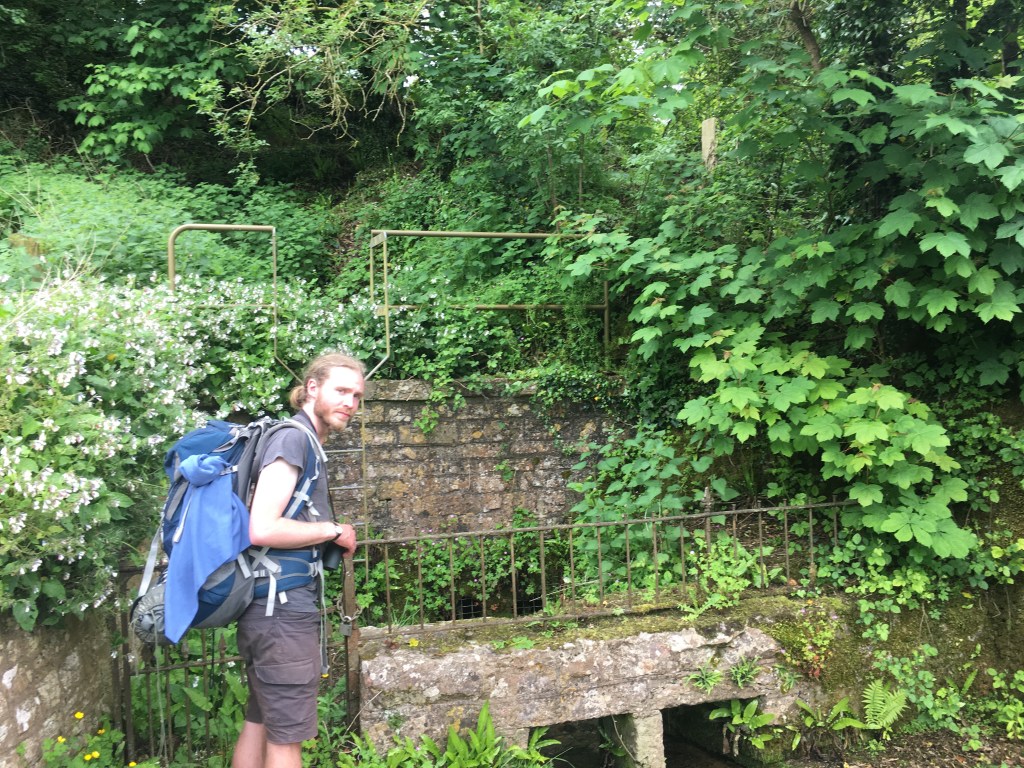
Bellies full, the river called and we began the final stretch towards Chewton Mendip where the source of the chew emerges. Disappointingly, this final leg is without footpath, so we keep ourselves sellotaped to the hedgerow to stay safe from cars. Crossing the A39 onto Cole’s lane, the map becomes useless as the thin blue line of the river chew drys up. A small stream still runs, and we follow it up a narrow path where lies a built up chamber of bricks with a flow of water coming from its base.
With no sign to affirm its identity as the source of the river chew and with no real idea of what a rivers source is supposed to look like, we un-ceremoniously trundle back towards the bus stop in Chewton Mendip where this journey ends.
As we wish for some local knowledge to resolve our uncertainty, our prayers are answered. Sat under a tree, tending to his horses, a man with a large beard and cowboy hat seems to spot the confusion on our faces and asks if we need help. Much to our delight, he is able to confirm our success in finding the source of the chew and is also able to layer on additional information about its story and some of the other springs that can be found in the area.
This man had a somewhat mythic essence, not just his strange roadside paddock or the rarity of hearing a northern accent in the Chew Valley, but also the timing of his appearance, a river nymph perhaps.
We eventually boarded the 376 after a compulsory rural wait time of thirty minutes, turning our minds and bodies back to our respective homes, bristol for ben and stanton drew for me. We parted ways at pensford, where I found myself fast tracked to the river banks of a much changed chew, no longer the gentle flow of its spring source, but a mature river of handsome ebbs and flows. Moving and winding as she does.
A recording of the folk songs ben and I sang hanging over Litton Reservoir can be found here: https://www.youtube.com/watch?v=5lG2GZyn7S0&t=275s
 Bricolage Gardening
Leave a comment